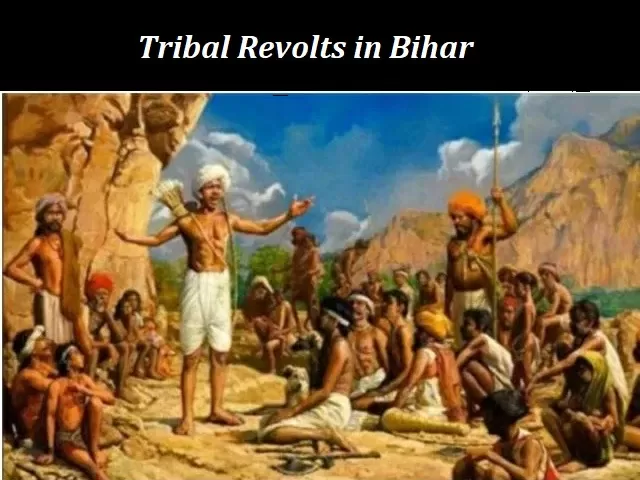
Tribal Revolt in Bihar
 The tribal communities in Bihar were indigenous groups who depended primarily on agriculture, handicrafts, and forest resources for their livelihood. They lived in close-knit societies, maintaining their traditional customs and practices.
Note In Tribal Uprisings Causes and Charecteristic are almost similar to every tribal revolt - so you can segregate them and can use similar points in different answers. |
Reason
Impact of British Policies
- Land Alienation: Loss of Land and Autonomy
- Tribal lands transferred to landlords and moneylenders under the British revenue system.
- Widespread loss of ownership over ancestral lands.
- Collaps - farming economies due to colonial policies.
- Economic Exploitation:
- Free trade policies undercut local handicraft industries, driving tribal artisans into poverty.
- Heavy tariffs on Indian goods further marginalized tribal economies.
- British officials imposed taxes, fines, and punishments on tribal communities.
- Forest Laws:
- Stringent laws restricted tribal access to forests, cutting off resources like food, firewood, and grazing lands.
- Criminalized traditional forest practices, leading to widespread resentment.
- Cultural and Social Disruption:
- Introduction of foreign legal systems disrupted tribal governance.
- Missionary activities and British interventions challenged traditional tribal identities.
- Industrialization Impact:
- Mass industrialization replaced traditional livelihoods with exploitative labor systems.
- Tribals forced into exploitative wage labour or displaced from their homes.
- Rise of Collective Resistance:
- Tribals organized uprisings, using guerrilla tactics against British authorities.
- Focused attacks on British officials, property, and collaborators
Characteristics of Tribal Revolt:
- Ethnic Solidarity: Revolts were driven by strong tribal identity and unity.
- Selective Targeting: Violence was aimed at exploitative outsiders like traders and moneylenders, not poor locals.
- Resentment Against British Rule: Seen as destroying traditional socioeconomic systems.
- Messianic Leadership: Many revolts were led by charismatic figures promising to end tribal suffering.
- Technological Disadvantage: Tribals relied on outdated weapons, which hindered their success.
Weaknesses of Tribal Revolts in Bihar (Brief and Provocative)
- Divided Leadership
- Tribal revolts lacked a central leadership, with each group fighting its own battle, making them easy to suppress.
- Primitive Weapons
- Tribals fought with bows, arrows, and spears—no match for British guns and artillery.
- Spontaneous and Chaotic
- Uprisings erupted without planning or coordination, leading to short-lived and disorganized resistance.
- No Strategic Alliances
- Tribals remained isolated, failing to join hands with other anti-British groups or broader nationalist movements.
- Internal Rivalries
- Tribal clans and factions were often divided, weakening their collective strength and unity.
- Manipulated by British
- The British exploited tribal ignorance and internal rivalries, bribing or co-opting some leaders to crush revolts.
- Brutal Repression
- The British used overwhelming force—mass killings, village destruction, and punitive laws—to terrorize and dismantle revolts.
- Geographic Isolation
- Tribes were scattered across remote regions, limiting their ability to communicate and form a unified front.
List of Tribal Revolts That Occurred In Bihar
Some of prominent tribal revolts in Bihar were Kol Uprisings, Munda Revolt, Tana Bhagat Movement, Munda Uprisings, Bhumij Revolt, and the biggest of all the rebellions and movements was the Santhal Uprising. Santhal Revolt was the most impactful revolt in the history of the Bihar tribes |
Santhal Rebellion[[refer main notes] Santhal Hul (also known as the Santhal Rebellion) was a significant uprising against both British colonial rule and the oppressive Zamindari system. The revolt took place primarily in the regions that now form parts of Jharkhand, Odisha, and West Bengal, and lasted from 1855 to 1856
|
Munda Uprising[refer main notes]
|
Kol Uprising (1831-32):
|
Bhumij Revolt (1832-33):
|
Tamar Revolt (1789–1832) It was a significant series of uprisings by the tribal communities of the Chota Nagpur plateau against British colonial rule. Below is a comprehensive summary:
Causes
Leaders
Events
Impact
|
Kherwar Movement:
|
Conclusion:
- Tribal revolts were fueled by British policies, particularly land revenue changes, that disrupted tribal life. While most uprisings failed due to technological and organizational disadvantages, some compelled the British to reconsider and modify their exploitative policies. But these movements continues to inspire struggles for justice and self-determination.
British Forest Law
British introduced comprehensive forest regulations in India to control the management, use, and exploitation of forest resources. Notable among these was the Indian Forest Act of 1865 and Indian Forest Act of 1878, which gave the government extensive powers to classify and manage forests. These laws aimed to regulate timber extraction, fuelwood collection, and other forest-based resources for economic purposes, particularly to serve the needs of British colonial industries, including the railways.
Impact:
- Displacement of Communities: Local and indigenous populations lost access to forests, disrupting their livelihoods.
- Economic Exploitation: Forests were commercialized to benefit the British economy, with resources extracted for export, often leading to depletion.
- Scientific Forest Management: British introduced "scientific" management, focusing on revenue over sustainability, neglecting local knowledge and ecological balance.
- Resistance and Rebellion: Forest restrictions led to local uprisings, such as the Chhota Nagpur Uprising (1855) and Mappila Rebellion (1921).
- Ecological Damage: Over-exploitation of forests led to deforestation and environmental degradation.
- Legacy of Control: Many policies continued post-independence, with the Indian Forest Act of 1927 still shaping forest management today.
UPSC Mains Questions
- UPSC GS Paper I (2013):
"Critically examine the role of tribal uprisings in the freedom struggle with a special reference to the Santhal rebellion (1855-56)." - UPSC GS Paper I (2018):
"Tribal revolts were a result of the alienation caused by British policies. Analyze with examples from the 19th century tribal movements." - UPSC GS Paper I (2021):
"Discuss the role of ethnic solidarity and leadership in tribal uprisings during the colonial period. Illustrate your answer with examples."
BPSC Mains Questions
- BPSC GS Paper I (2021):
"Analyze the causes and impact of the Santhal Rebellion of 1855-56 in Bihar." - BPSC GS Paper I (2017):
"Describe the impact of British land and forest policies on tribal communities in Bihar. How did these policies lead to uprisings like the Kol and Bhumij revolts?" - BPSC GS Paper II (2018):
"Explain the significance of the Munda Ulgulan and its contribution to tribal resistance in the Chotanagpur region." - BPSC GS Paper I (2020):
"Discuss the role of charismatic leadership in tribal revolts with specific reference to Sidhu and Kanhu Murmu during the Santhal Hul."
Model Question
Short Answer Questions:
- Explain the primary causes of tribal revolts in Bihar during British colonial rule.
- What role did land alienation play in triggering tribal uprisings in Bihar?
- Discuss the significance of the Santhal Rebellion in the history of tribal revolts in Bihar.
- Describe the impact of British forest laws on tribal communities in Bihar.
- How did economic exploitation under British rule contribute to tribal resistance movements in Bihar?
- Who were the main leaders of the Munda Uprising, and what were their main grievances?
- What were the key characteristics common to the tribal revolts in Bihar?
- Discuss the role of ethnic solidarity in the tribal revolts of Bihar.
- What was the legacy of the Kol Uprising in the context of tribal resistance in Bihar?
- Highlight the impact of the Bhumij Revolt on British colonial policies.
Long Answer Questions:
- Analyze the various factors that led to the tribal revolts in Bihar, with specific reference to the causes, characteristics, and leadership of these uprisings.
- Discuss the British response to the tribal revolts in Bihar and how these revolts influenced future colonial policies, particularly in relation to tribal land and rights.
- Evaluate the significance of the Santhal Rebellion in shaping tribal consciousness and its broader implications for resistance movements in colonial India.
- Compare and contrast the leadership and methods of resistance in the Munda and Kol uprisings in Bihar.
- What role did cultural and social disruption caused by British rule play in the tribal uprisings in Bihar?
- In what ways did the tribal uprisings in Bihar contribute to the evolution of British policies towards tribal communities and their land rights?
- Critically examine the role of messianic leadership in the tribal revolts of Bihar, with examples from specific uprisings.