

Global Warming
Global warming is defined as an average rise in temperature of atmosphere near Earth’s surface and in troposphere, which can cause changes in climate patterns globally.
SDG - 7,11,13.
NOAA (National Oceanic and Atmospheric Administration) Temp Data: 2022 was the sixth- warmest year on record.
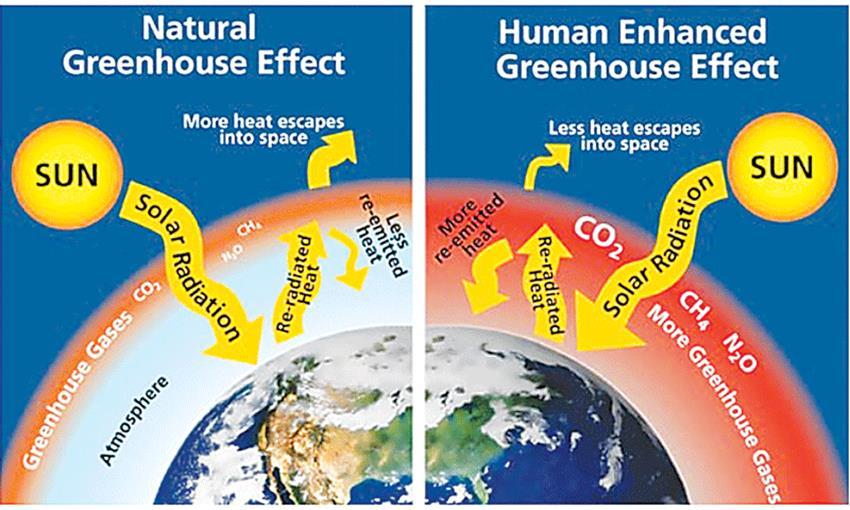
Causes
Natural Causes:
- Continental drift: due to plate displacement and drift position of water bodies of landmass and flow of ocean currents and winds have changes.
- Volcanoes: emits large volumes of greenhouse gases such, sulphur dioxide (SO2), water vapour, dust, and ash.
- Ocean currents: oceans absorb more heat from atmosphere this leads to increase in sea surface temperature and this disrupts the ocean circulation patterns that transport warm and cold water around the globe.
- Permafrost: As permafrost melts, the Earth itself starts to release its reserves of greenhouse gases (CO2 and methane).
Anthropogenic Causes:
- Greenhouse Gas (GHGs): Due to increased human activities and industrial revolution,
- Carbon dioxide (CO2): Burning fossil fuels (coal, oil, natural gas) for energy and transportation is the largest source of CO2 emissions.
- Methane (CH4): Emitted from agriculture (livestock), landfills, and the production and transport of fossil fuels.
- Nitrous oxide (N2O): Mainly from agricultural and industrial activities.
- Aerosols: Aerosols are fine liquid and solid particles suspended in air. The amount of very fine material generally referred as “PM2.5”.
- Direct impact on climate change as they absorb radiations which results into warming of atmosphere, For e.g. black and brown carbon, warm the Earth’s atmosphere, while sulphate droplets, cool it.
- Changes in land cover: On a global scale, patterns of vegetation and climate are closely correlated
Deforestation:
- Cutting down trees reduces the Earth's capacity to absorb CO2,
Energy Production:
- Fossil Fuels: Burning coal, oil, and natural gas for electricity
Impact
- Economic:
- Acc to an estimation, climate change could cost about 5 to 20% of the annual global GDP.
- Hurricanes, cyclones and typhoons devastate millions of people, pushing them in absolute poverty.
- Droughts shrink harvests:
- Social:
- Impact on daily lives: Affect the livelihoods of people, in terms of employment, health, housing, water, food.
- Environmental:
- Threat to biological diversity:
- Water stress and water insecurity: Changed run-off patterns and glacial melt will add to ecological stress, compromising flows of water.
- Shifts in temperatures and precipitation patterns may reshape boundaries between grasslands, shrublands, forests and other ecosystems thus altering ecological balance.
- Forest fires: Hot temperatures and dry conditions increase the likelihood of forest fires.
- The Glacial Melt:
Ocean ecosystem:
- Rising Sea level:
- Sea-Level Rise: Average sea levels have risen over 8 inches (about 23 cm) since 1880.
CLIMATE CHANGE: CAUSES, CONSEQUENCES AND INITIATIVES
According to UN, climate change is defined as a long shift in temperature and weather patterns. Such a shift can either be natural[such as volcanic activity] or anthropogenic[burning of fossil fuel]
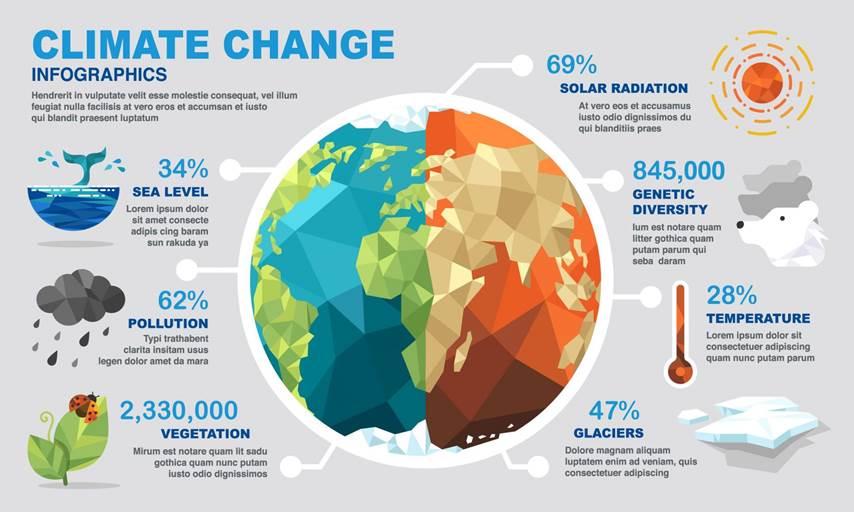
CAUSES OF CLIMATE CHANGE
- Natural Causes:
- Volcanic activity: Volcano eruption leads to the emission of GHGs such as sulphur dioxide (SO2), water vapour, dust, and ash into the atmosphere. Thus responsible for climate change.
- Oceanic circulation: Changes in the natural oscillations such as El Niño-Southern Oscillation (ENSO) and the Atlantic Multidecadal Oscillation (AMO), affect the distribution of heat and moisture.
- Variation in solar activity: Sunspot activity, fluctuation in incoming solar radiation and Milankovitch cycles can influence climate change.
- Anthropogenic Causes:
- Generation of electricity: Persistent burning of fossil fuels for the generation of electricity and heat is responsible for a major chunk of greenhouse gas emissions.
- Clearing of the forest: Forests have been cleared for pasture land, agriculture or for urban development. This has destroyed natural carbon sinks, thus, releasing an unprecedented amount of carbon dioxide into the atmosphere.
- Aerosols: Aerosols cause scattering and absorption the solar and infrared radiation. For instance, black and
brown carbon, has a warming effect on the Earth’s atmosphere, while others, like sulphate droplets, cool it.
- Over-consumption: Consumerist lifestyle is responsible for a high carbon footprint.
- Transportation: Private vehicle emission is one of the major causes of GHG emissions in Indian and globally.
CONSEQUENCE OF CLIMATE CHANGE
- Economic:
- According to the RBI’s report, by 2030, extreme heat and humidity may adversely affect labour hours and up to
4.5 % of India’s GDP could be at risk.
- According to an estimate, heat stress may lead to about 8 crore job losses globally by 2030.
- Cost of Climate Chanage: It is estimated that if action is not taken to address the carbon emissions, climate change could cost about 5 to 20% of the annual global GDP.
- World Bank, if mitigation steps are not taken immediately, climate change could push 100 million more people into poverty by 2030.
- Industrial sector: Increase in cost of production and decrease in profit margin due to imposition of new climate- friendly regulations.
- Agriculture: Falling crop yields, especially in NW India
- Livelihoods: Agriculture, tourism, fisheries affected
- Infrastructure damage with 2°C rise in temperature
- Social:
- Displacement and migration: Extreme climate events have forced people to migrate. This led to the emergence of ‘climate refugees’. For instance, according to an estimate, by 2050, 17% of Bangladesh would be flooded, which may lead to 20 million climate refugees from Bangladesh.
- Health: Increased risk of new infectious diseases and spread of infection with climate refugees.
- Food insecurity: Extreme climate events have adversely affected agriculture productivity. Thus creating a burden on the limited resources.
- Social instability: Climate change exacerbate geopolitical tension and social inequality.
- Environmental:
- Threat to biological diversity: ex Bramble Cay melomys, the first mammal to extinct due to climate change.
- Water stress and water insecurity:
- Submergence of low-lying coastal areas like Sundarbans
- Transborder water management issues (e.g., Indus, Brahmaputra)
- Extreme climate events (cloudbursts, heatwaves)
- Changing landscape: Shifts in temperatures and precipitation may reshape the boundaries between the landscapes including grasslands, shrublands, forests and other ecosystems.
- Melting of glacier and polar icecap: This contributes to the rise in sea level, loss of biodiversity, a threat to coastal habitat,and release of dormant pathogens.
- Glaciers in 21 out of 46 natural World Heritage sites may disappear by 2100.
- Arctic amplification: Arctic warming twice as fast as the global average;
- Sea Level Rise: Could reach 60-110 cm
- Extreme climate events - devastating climate phenomena including, severe droughts, floods, storms, forest fires, etc.
- Ocean ecosystem:
- Rising Sea level: The global average sea level has risen by 10 to 20 cm over the past 100 years.
- Ocean acidification: The rising concentration of carbon dioxide
- Increase in sea surface temperature: may trigger cyclonic activities.
- Marine heatwaves (MHW):
- Forest Fire –
- Increase temperature and extreme event like Drought Heat waves has increase its Intensity
- Other Points
- Heat Waves:
- Urban Heat Islands: Urban areas have significantly higher temperatures than surrounding rural
- Weather Patterns: Atlantic Meridional Overturning Circulation weakening.
INTERNATIONAL EFFORTS TO COMBAT CLIMATE CHANGE
- Carbon Border Adjustment Mechanism (CBAM): An initiative by the European Union that would levy a carbon tax on products imported which are made from a non-environmental sustainable process.
- Carbon Capture Utilisation And Storage (CCUS): Methods and techniques to reduce, capture, and store carbon dioxidefrom flue gases and the atmosphere.
- Climate Tipping Points: Points or threshold beyond which changes in climate perpetuate themselves due to global warming which is a great cause of concern.
- Intergovernmental Panel on Climate Change (IPCC): IPCC provides a mechanism to study the effects of global warming at a governmental level. IPCC assesses the science related to climate change.
- United Nations Framework Convention on Climate Change (UNFCCC): obj of Convention is to stabilize greenhouse gas concentrations "at a level that would prevent dangerous anthropogenic (human-induced) interferencewith the climate system”.
- Kyoto Protocol: This protocol holds developed countries accountable for current high levels of GHG emissions into atmosphere due to their role in the industrial revolution. Kyoto Mechanism includes Emission Trading, the Clean Development Mechanism and Joint Implementation.
- Paris Agreement: It is considered to be world’s first comprehensive climate agreement. It aims to keep global temp well below 2°C and preferably limit it to 1.5° Celsius, compared to pre-industrial levels.
- REDD+: to provide financial incentives to developing countries to reduce their greenhouse gas emissions from deforestation and forest degradation
CLIMATE CHANGE AND INDIA
India is currently the third-largest emitter of greenhouse gases, following China and the USA.
Despite 3rd largest India's overall contribution to global greenhouse gas emissions is 7.5%.
India’s historical contribution to global GHG emissions is about 4% against a share of ~17% of the world’s population (Climate Equity Monitor),
India's per capita emissions are relatively low at 1.3 tonnes/per person per year - USA 4 tonnes/per person per year
India Effort
Adaptation Strategies
- Soil Health Cards – Provides farmers with information on soil nutrient status, enabling better soil management and reducing excessive fertilizer use.
- Paramparagat Krishi Vikas Yojana (PKVY) – Promotes organic farming by reducing dependency on chemical fertilizers and pesticides.
- Neeranchal – Watershed Development Programme – Enhances water conservation and sustainable farming practices.
- National Mission for Clean Ganga (NMCG) – Focuses on pollution control, river rejuvenation, and sustainable water use.
- National Bureau for Water Use Efficiency (NBWUE) – Aims to improve efficiency in water consumption across various sectors.
- ‘Give It Up’ Campaign – Encourages voluntary surrender of LPG subsidies to benefit economically weaker sections.
- Health Programmes (Vector-Borne Diseases) – Strengthening public health infrastructure to combat malaria, dengue, and other climate-sensitive diseases
- Protection of Coastal Zone – Integrated Coastal Zone Management (ICZM) – Ensures sustainable coastal development and biodiversity conservation.
- Small Island Protection (IPZ) – Focuses on ecological conservation and disaster preparedness for small islands.
- Disaster Management (Sendai Framework – ARR) – Strengthens resilience through risk assessment, preparedness, and response.
- PM Krishi Sinchai Yojana (Micro-Irrigation) – Aims at enhancing water use efficiency in agriculture through drip and sprinkler irrigation.
- Insurance, Social Security & Livelihood Security – Schemes like PMFBY (crop insurance), PMSBY (accident insurance), and MNREGA for employment security.
- Climate-Resilient Infrastructure Measures – Infrastructure planning to withstand extreme weather events and rising sea levels.
Mitigation Strategies
- Increasing Share of Renewables – Scaling up solar, wind, and hydroelectric power.
- National Solar Mission – Aims for 100 GW solar power capacity by 2022.
- Green Energy Corridors – Facilitating the integration of renewable energy into the national grid.
- Clean Coal Policies – Adoption of supercritical and ultra-supercritical technologies in thermal plants.
- National Biofuels Policy – Promotes bioethanol, biodiesel, and advanced biofuels to reduce fossil fuel dependency.
- Enhancing Energy Efficiency (BEE Initiative) – Implementing energy-efficient measures across industries and buildings.
- Green Highways Project – Focuses on tree plantation along highways to absorb carbon emissions.
- National Agro-Forestry Policy – Promotes tree planting on farmlands to enhance carbon sequestration.
- Curtailing Subsidies on Fossil Fuels – Gradual removal of petroleum and diesel subsidies to encourage cleaner alternatives.
- Coal Cess (₹400/ton) – Levy on coal to fund renewable energy and environmental initiatives.
Other Initiatives
- KUSUM Scheme – Promotes solar power generation for irrigation and agriculture.
- Ultra-Mega Solar Parks – Large-scale solar power projects to increase capacity.
- Solar Rooftop Programme – Incentivizes rooftop solar installations to decentralize renewable energy.
- Perform, Achieve, and Trade (PAT) Scheme – Market-based mechanism for improving industrial energy efficiency.
- Ujjwala Yojana – Provides subsidized LPG connections to poor households to reduce biomass burning.
- UJALA Scheme – Promotes LED usage to enhance energy efficiency.
- FAME India (Faster Adoption and Manufacturing of Electric Vehicles) – Supports electric mobility adoption.
Market Mechanisms and Policy Measures
- Uniform Carbon Trading Market – Enables buying and selling of carbon credits to incentivize emission reductions.
- India Cooling Action Plan (ICAP) – Targets sustainable cooling practices while protecting the ozone layer.
- National Action Plan on Climate Change (NAPCC) – Comprises 8 missions to address climate change challenges.
- Mission LiFE (Lifestyle for Environment) – Encourages environmentally conscious behavior and daily actions.
India’s Net Zero Targets & Commitments
- Net Zero Target by 2070 – India’s commitment at COP26 to balance carbon emissions.
- Net Zero Target by 2030 for Indian Railways – Aims for a carbon-neutral railway Network.
India’s Panchamrit Pledge at COP26 –
- Reduce carbon emissions by 1 billion tons.
- Reduce emission intensity of GDP by 45%.
- Increase non-fossil fuel energy capacity to 500 GW by 2030.
- Increase renewable energy share in energy mix to 50% by 2030.
- Achieve net zero emissions by 2070.
Green Energy and Biofuel Initiatives
- Promoting Green Hydrogen – Development of hydrogen as a clean energy alternative.
- Promoting Biofuel – Utilization of bioethanol and biodiesel to lower dependence on conventional fuels.
International Collaborations & Alliances
- International Solar Alliance (ISA) – Promotes solar energy cooperation among member countries.
- Coalition for Disaster Resilient Infrastructure (CDRI) – Enhances infrastructure resilience against climate disasters.
- Green Grids Initiative – One Sun, One World, One Grid (OSOWOG) – Global initiative to interconnect renewable energy grids.
- Mission LiFE (Lifestyle for Environment) – Encourages global sustainable living practices.
PRESENT CHALLENGES RELATED TO INDIA’S CLIMATE ACTION
- Excessive Coal dependency: Coal continues to be a driving force behind electrification in India and plays an important role in the energy security of the country.
- High population: It has led to increased energy demand which contributes to GHG emissions.
- Environment vs Development: India’s commitment to net zero transition could potentially have implications on
- growth, on the economy and on energy availability for industrialisation and urbanisation.
- Delayed timeline: Scientists have advised countries to go net zero latest by 2050 and move on to negative emissions to mitigate the worst effects of the climate crisis.
- Emissions from the agricultural sector: India's food and fertilizer subsidies have significantly contributed to climate change leading to high GHG emissions, especially in paddy cultivation.
- Implementation bottlenecks: institutional, systemic and process barriers, including financial constraints, inter- ministerial coordination, lack of technical expertise and project clearance delays.
- Inadequate legal mechanism: Existing laws are inadequate to deal with climate change and do not contain provisions specifically to reduce future climate impacts and tackle environmental/climate violations.
WAY FORWARD
- Budgetary Allocation: A vital step should be explicit including policies for climate mitigationin govt budget, along with energy, roads, health and education.
- Collaborative Mitigation strategy: National mitigation and preparedness strategy should have collaborated with international efforts for maximum impact.
- Bottom-up Approach: Bottom-up approach, by understanding the needs of the community at the local level, rather than providing directions from the leadership would make resilient efforts against climate change.
- Robust Climate Change Adaptation: Economies should move towards carbon-neutral measures of economic development. For instance, the spirit of the E-mobility scheme, Energy Conservation Building Code and other measures should be realised.
- Setting up Early Warning Systems: This would help to alert the downstream populations about an impending disaster.
- Awareness generation: Along the line of the Swachha Bharat Mission, awareness among the masses about climate change should be taken on mission mode.
- Nudge policy towards adopting environmentally friendly habits.
- Encouraging private participation: Private entities should be promoted and incentivised for their active participation in India’s transition towards the green economy.
- WAY FORWARD: ‘TACKLE’
- T – Time Bound Action Plan - Meet & enhance Paris deal commitments ➔ More ambitious target by developed & developing countries to keep global warming below 1.5 º C ➔ Climate Change Mitigation
- A - Adaptation of agriculture, infrastructure, lifestyle etc ➔ Nature Based Solutions
- C - Common But Differentiated Responsibility & Historical Responsibility principles – Mobilise Climate Finance & Technologies from Developed Countries (Historical Polluters) & Ensure ‘Just Transition’.
- K - Knowledge management, capacity building, & Carbon markets (Finalize the Article 6 rulebook)
- L – Set up Loss and damage funds
- E - Enhance cooperation and collaboration - via International alliances - ISA, CDRI and collaboration with private sector, media, NGOs etc
2023 Hottest Year on Earth
year 2023 marked a significant point in climate history, being the hottest year on record with global temperatures rising 1.46°C above pre-industrial levels. This temperature increase is alarmingly close to the 1.5°C threshold set by the Paris Agreement, a critical limit to avoid the most catastrophic impacts of climate change.
- Global Temperature Rise
- Temperature Increase: In 2023, global temperatures increased by 1.46°C above pre-industrial levels, approaching 1.5°C threshold established by the Paris Agreement.
- Record-Breaking Heat: Every month since June 2023 set new temperature records, with November witnessing days where temperatures exceeded 2°C above pre-industrial levels.
- Impact of El Niño
- Warming Influence: The El Niño event that strengthened during the summer of 2023 is expected to further elevate global temperatures in 2024.
- El Niño’s Effect: Historically, the most significant temperature impacts of El Niño occur after the event reaches its peak, suggesting continued warming effects in the near future.
- Arctic Temperature Extremes
- Record Warmth: The Arctic experienced its warmest summer in recorded history in 2023, with temperatures rising nearly four times faster than the global average since 1979.
- Consequences: This contributed to the Arctic's sixth-warmest year since 1900, resulting in severe effects like wildfires, flooding, and food insecurity.
- Consequences in the Arctic
- Thawing Subsea Permafrost: Accelerated thawing of subsea permafrost in the Arctic is releasing more greenhouse gases, exacerbating global warming and ocean acidification.
- Food Insecurity: Declines in salmon populations in Western Alaska have adversely affected Indigenous communities and local fisheries.
- Raging Wildfires: Canada endured its worst wildfire season on record, with over 10 million acres burned, and smoke affecting air quality as far south as the United States.
- Severe Flooding: The melting of the Mendenhall Glacier in Alaska led to unprecedented flooding in Juneau.
- Greenland Ice Sheet Melting: The Greenland ice sheet experienced record levels of melting in 2023, significantly contributing to sea-level rise.
- Looking Ahead
- Future Projections: The World Meteorological Organization (WMO) forecasts continued warming in 2024 due to ongoing and intensifying climate change impacts.
- Urgency for Action: The next seven years are crucial for reducing emissions and enhancing resilience against climate change effects.
This information highlights the urgent need for global action to mitigate climate change and adapt to its inevitable impacts.
Extreme Weather Events (EWE)
Definition & Characteristics
- Extreme Weather Events (EWE) refer to unusual, unexpected, and unpredictable severe or unseasonal weather conditions that deviate significantly from historical climate patterns.
- These events include heatwaves, extreme precipitation, marine heatwaves, cyclones, wildfires, droughts, and cold waves.
- According to the Intergovernmental Panel on Climate Change (IPCC), human-induced climate change has significantly increased the frequency and intensity of these events.
Examples of Recent Extreme Weather Events
Event | Year | Location | Impact |
Pakistan Floods | 2022 | Pakistan | Over 33 million affected, large-scale displacement, and economic loss (UN Report). |
India Heatwaves | 2022 | India | Temperature crossed 49°C, severe health crises, reduced agricultural yield. |
Australian Bushfires | 2019-2020 | Australia | Burned over 18 million hectares, severe biodiversity loss. |
Cyclone Amphan | 2020 | India & Bangladesh | Economic losses of $13 billion, mass displacement. |
Marine Heatwaves | 2023 | Global | Warming oceans affecting marine biodiversity and fishery-dependent economies. |
Impact of Extreme Weather Events
1. Environmental & Ecological Impact
- Ecosystem Disruption: Wildfires, floods, and extreme temperatures threaten biodiversity and lead to habitat loss.
- Coral Bleaching: Marine heatwaves cause mass coral bleaching, affecting aquatic ecosystems.
- Positive Climate Feedback Loop: EWE accelerate glacier melt, permafrost thawing, and methane release, intensifying global warming.
- Desertification & Soil Degradation: Droughts and deforestation increase desertification risks, affecting agricultural productivity.
2. Socio-Economic Impact
- Food & Water Insecurity: Droughts and floods disrupt agriculture and water availability, leading to malnutrition and migration.
- Loss of Livelihoods: Sectors like agriculture, fisheries, forestry, and tourism are directly impacted.
- Health Crisis: Heatwaves increase heatstroke, dehydration, and respiratory illnesses, while floods promote waterborne diseases.
- Migration & Displacement: Climate-induced disasters cause forced displacement, leading to socio-political conflicts (e.g., Bangladesh & Maldives face severe risks due to sea-level rise).
- Economic Damage: Infrastructure destruction (roads, bridges, power grids) increases recovery costs, especially in developing nations.
Challenges in Tackling Extreme Weather Events
1. Governance & Preparedness Challenges
- Limited Early Warning Systems: One-third of Least Developed Countries (LDCs) lack efficient warning mechanisms.
- Lack of Climate-Resilient Policies: Poor urban planning leads to increased vulnerability (e.g., flood-prone construction, weak building codes).
- Inconsistent Climate Action: Despite the Paris Agreement, many countries fail to meet emission targets.
2. Scientific & Technological Challenges
- Predictability & Uncertainty: Due to complex atmospheric interactions, it is difficult to forecast extreme events accurately.
- Data Gaps: Limited historical climate data for developing regions reduces adaptive capacity.
3. Socio-Economic Challenges
- Inequality & Resource Distribution: Vulnerable groups (small-island nations, indigenous communities) face disproportionate impacts.
- Financial Constraints: Many nations lack adequate funding for adaptation strategies, resilient infrastructure, and recovery measures.
- Unplanned Urbanization: Slum settlements in low-lying coastal areas and floodplains increase risks.
Way Forward: Strategies to Mitigate & Adapt to EWE
1. Strengthening Disaster Preparedness
- Enhancing Early Warning Systems: Implement AI-based climate modeling for real-time disaster alerts.
- Investing in Climate-Resilient Infrastructure: Flood-resistant roads, cyclone-proof housing, sustainable drainage systems.
- Community-Based Disaster Risk Reduction (CBDRR): Localized training programs for disaster response.
2. Climate Mitigation Measures
- Reducing Greenhouse Gas Emissions: Transition to renewable energy (solar, wind, hydro) to limit global warming.
- Sustainable Land & Water Management: Promoting reforestation, soil conservation, and rainwater harvesting.
- Eco-Friendly Urban Planning: Expanding green spaces, permeable pavements, and smart drainage systems.
3. Climate Adaptation & Resilience Building
- Insurance & Financial Mechanisms: Expand climate risk insurance for farmers and small businesses.
- Carbon Pricing & Green Investments: Encourage public-private partnerships to fund green initiatives.
- Ecosystem-Based Adaptation (EBA): Restoration of mangroves, wetlands, and coastal buffers to absorb climatic shocks.
4. Global & Policy-Level Actions
- Implementing Paris Agreement & IPCC Recommendations: Stricter emission reduction policies.
- Climate Financing & Technology Transfer: Developed nations should support developing countries with funds & technology.
- International Cooperation: Strengthening frameworks like Sendai Framework for Disaster Risk Reduction (SFDRR) and UNFCCC Adaptation Fund.
Conclusion
Extreme Weather Events are increasingly frequent and severe due to climate change, posing existential threats to ecosystems, economies, and human lives. Addressing these challenges requires integrated disaster preparedness, scientific advancements, and strong policy frameworks. The global community must prioritize mitigation, adaptation, and resilience-building efforts to minimize future losses and safeguard vulnerable populations.


