

Operation Sindoor
Context:
On April 22, 2025, a brutal terrorist attack in Pahalgam, Jammu & Kashmir, killed 26 civilians, including 25 Indians and 1 Nepali tourist. The Resistance Front (TRF), linked to Lashkar-e-Taiba (LeT), claimed responsibility. In response, India launched “Operation Sindoor” on May 7, 2025, targeting terror infrastructure in Pakistan and Pakistan-Occupied Kashmir (POK).
Key Features of Operation Sindoor
- Date: May 7, 2025
- Objective: Surgical strikes to dismantle terror networks of Jaish-e-Mohammed (JeM) and Lashkar-e-Taiba (LeT)
- Scope: 9 Terror-linked sites struck in Pakistan (4) and POK (5)
- Duration: ~23 minutes
- Nature: Focused, calibrated, and non-escalatory – aimed at terror hubs only, avoiding military/civilian infrastructure
- Forces Involved: Indian Army, Navy, and Air Force in a joint operation
- Command: Executed under the strategic guidance of the Ministry of Defence with real-time intelligence and coordination
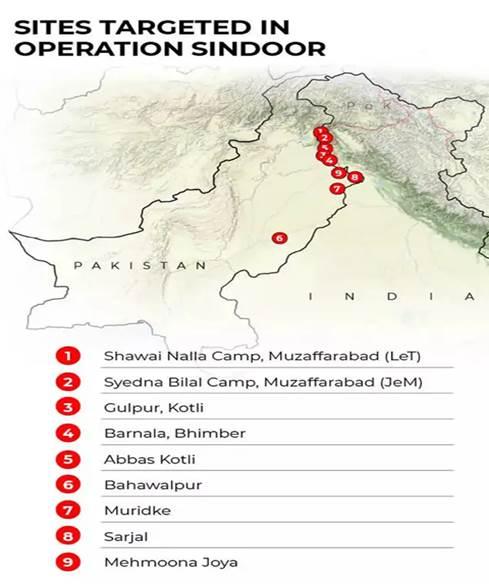
Terror Sites Targeted in Operation Sindoor
Location | Function / Affiliation |
Markaz Subhan Allah, Bahawalpur | Headquarters of Jaish-e-Mohammed |
Markaz Taiba, Muridke | Lashkar-e-Taiba base |
Mehmoona Joya, Sialkot | Hizbul Mujahideen camp |
Markaz Ahle Hadith, Barnala | LeT-linked religious indoctrination center |
Syedna Bilal Camp, Muzaffarabad | JeM training camp |
Shwawai Nalla Camp, Muzaffarabad | LeT operational unit |
Makaz Raheel Shahid, Kotli | Hizbul Mujahideen command center |
Markaz Abbas, Kotli | JeM safehouse |
Sarjal Facility, Tehra Kalan | Weapons and IED storage hub |
Weapons Used in Operation Sindoor
Weapon System | Manufacturer | Role / Function |
SCALP Cruise Missile | MBDA (Europe) | Long-range precision strike from Rafale aircraft |
HAMMER Munition | Safran Electronics (France) | Modular bomb for mobile/concealed targets |
Loitering Munitions | Multiple sources (generic) | Kamikaze drones with surveillance + strike ability |
- Launch Origin: All strikes were launched from within Indian territory using precision-guided munitions.
- Intended Outcome: Minimize collateral damage, eliminate high-value terror assets, and send a strategic signal.
Consequences
- Airspace Disruption: Civilian flights suspended at key airports — Srinagar, Jammu, Leh, Amritsar, Chandigarh, Dharamshala, Bikaner.
- International Impact: Qatar Airways and other global carriers temporarily halted Pakistan-bound flights.
- Military Readiness: Pakistan Air Force placed on high alert; troop movements reported near LoC.
- Civilian Advisory: Airlines like IndiGo, SpiceJet, and Air India issued travel alerts or suspended services.
- Geopolitical Tension: International community urged restraint; UN and major powers monitored escalation risk.
Significance
- Strategic Precision: Demonstrated India's capability to launch surgical air/missile strikes with minimal collateral damage.
- Intelligence-Driven: Operation based on real-time intel; avoided Pakistani military sites, showing restraint and clarity.
- Doctrinal Shift: Continuation of post-Uri and Balakot proactive strike doctrine — deterrence through direct retaliation.
- Tri-Force Coordination: Seamless integration of Army, Navy, and Air Force operations within Indian territory.
- Message to Adversaries: Clear signal to terror outfits and their sponsors — India will retaliate beyond its borders if provoked.
- Public & Political Support: Widespread national support; reinforced government's strong security stance ahead of elections.
- Global Credibility: Enhanced India’s image as a responsible but assertive power in counter-terror strategy.
Operation Sindoor in the Context of India's Military Operations
Chronological table of major Indian operations (military + humanitarian)
Year | Operation Name | Nature | Objective / Context |
1948 | Operation Polo | Military | Integration of Hyderabad into India; action against the Nizam’s forces. |
1961 | Operation Vijay | Military | Liberation of Goa, Daman, and Diu from Portuguese control. |
1984 | Operation Blue Star | Military | Removal of militants from Golden Temple, Amritsar. |
1984 | Operation Meghdoot | Military | Securing Siachen Glacier from Pakistani occupation. |
1986-88 | Operation Black Thunder | Military | Flush out remaining militants from Golden Temple complex. |
1986-87 | Operation Brasstacks | Military Exercise | Large-scale military exercise near Pakistan border; led to tensions. |
1987-1990 | Operation Pawan | Military | IPKF deployment in Sri Lanka to disarm LTTE under Indo-Sri Lanka Accord. |
1988 | Operation Cactus | Military | Prevented coup in Maldives; airlifting troops to restore President Gayoom’s rule. |
1999 | Operation Vijay | Military (Kargil War) | Eviction of Pakistani intruders from Indian posts in Kargil. |
2001–2002 | Operation Parakram | Military Deployment | Massive troop mobilization after 2001 Indian Parliament attack. |
2013 | Operation Rahat | Humanitarian | Rescue and relief during Uttarakhand flash floods. |
2016 | Surgical Strikes | Military | Cross-LoC strike in response to Uri terror attack. |
2017 | Operation All Out | Military | Anti-terrorist operations in Jammu and Kashmir targeting multiple groups. |
2019 | Balakot Air Strike | Military | Retaliation to Pulwama terror attack by striking Jaish-e-Mohammed camps in Pakistan. |
2021 | Operation Devi Shakti | Evacuation | Evacuation of Indians and Afghan nationals post-Taliban takeover of Afghanistan. |
2022 | Operation Ganga | Evacuation | Evacuation of Indian students during Russia-Ukraine conflict. |
2023 | Operation Dost | Humanitarian Aid | Relief and rescue in earthquake-hit Turkey and Syria. |
2023 | Operation Kaveri | Evacuation | Evacuation of Indians from war-torn Sudan. |
Conclusion
Operation Sindoor stands as a landmark in India’s evolving counter-terrorism strategy, showcasing a new paradigm of precision, proportionality, and preparedness. It reinforces India’s resolve to eliminate cross-border terrorism while maintaining diplomatic and military calibration to avoid escalation. In the historical trajectory of Indian military operations, Sindoor reflects continuity in assertive defence doctrine, while adding new layers of technological and strategic sophistication.


