

India’s Foreign Policy in its Neighbourhood
Introduction
- India’s neighbourhood comprises South Asia and adjoining Indian Ocean Region (IOR), encompassing nations with shared historical, cultural, and economic ties.
- Policy evolution shaped by colonial legacy, Cold War dynamics, post-liberalisation economic interests, and current geopolitical competition.
- Central pillar: Peaceful, prosperous, and cooperative neighbourhood to ensure regional stability and India’s strategic security.
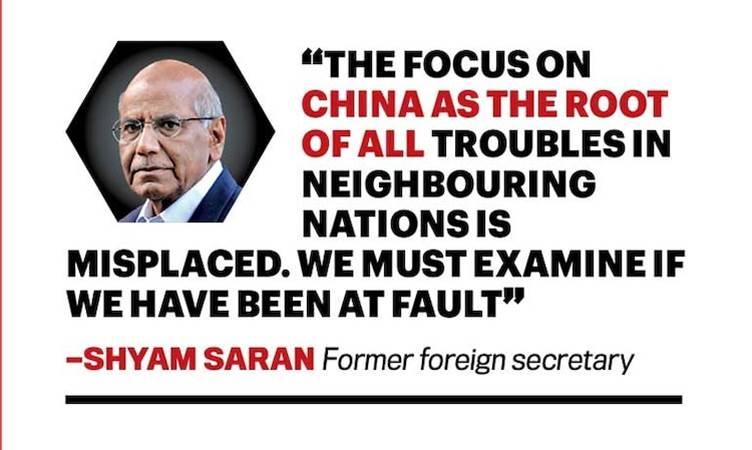
Geographical Scope
- Core neighbours: Afghanistan, Bhutan, Bangladesh, Maldives, Pakistan, Nepal, Myanmar, Sri Lanka, and the Tibetan Autonomous Region of China.
- Wider sphere: Includes Indian Ocean littorals under IORA, BIMSTEC.
- Strategic diversity: Variance in size, economic strength, governance models, and external alignments.
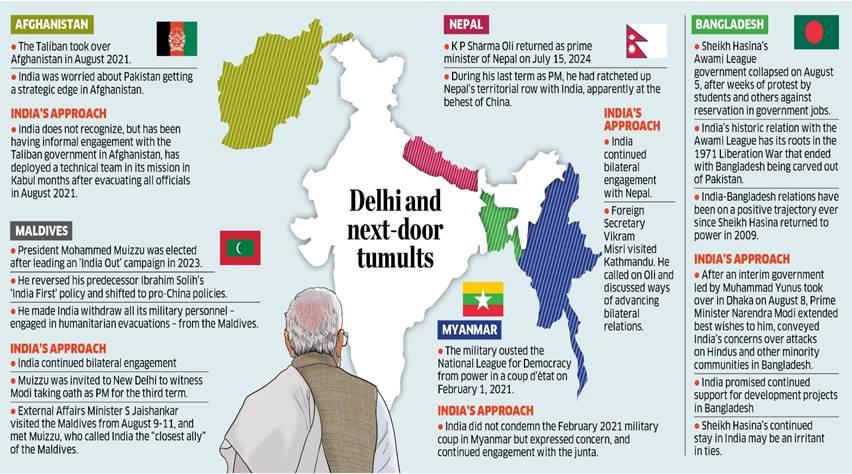
Evolution of Policy Towards Neighbours
1. Colonial Legacy (Pre-1947)
- Buffer zones (Afghanistan, Tibet) to protect British India.
- Treaty of Sagauli (1816) – Nepal ceded territory to British.
- Anglo-Bhutanese Treaty (1865) – Control of Assam passes.
- Annexation of Burma (1824–1885) for resource exploitation.
- Sri Lanka under British until 1948.
2. Early Independence Era (1950s–60s) – Idealism
- Non-Aligned Movement (NAM) – Balancing Cold War blocs.
- Panchsheel Agreement (1954) – Five principles with China.
- 1962 Indo-China War – Security reorientation.
- 1965 Indo-Pak War – Kashmir conflict deepened.
3. Assertive Phase (1970s–80s)
- 1971 Bangladesh Liberation War – Strategic intervention.
- Formation of SAARC (1985) for regional cooperation.
- India–Sri Lanka Accord (1987) – Political settlement effort.
- Operation Cactus (1988) – Maldives coup prevention.
4. Post-Cold War Pragmatism (1991–2013)
- Look East Policy (1991) – ASEAN engagement.
- Gujral Doctrine (1996) – Non-reciprocal goodwill to neighbours.
- Formation of BIMSTEC (1997) & IORA (1997).
5. Neighbourhood First (2014–Present)
- Priority to South Asia & IOR partnerships.
- PM invited SAARC leaders to 2014 swearing-in.
- Landmark India–Bangladesh Land Boundary Agreement (2015).
- Vaccine Maitri during COVID-19 pandemic.

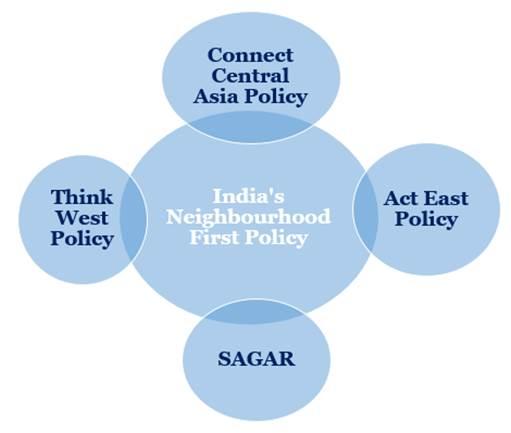
Key Initiatives with Neighbours
1. Regional Policies
- Neighbourhood First Policy – Peace, prosperity, connectivity, mutual respect.
- Act East Policy – Deepening ASEAN ties via Northeast India as gateway.
2. Connectivity & Infrastructure
- Kaladan Multimodal Project – India–Myanmar.
- BBIN Motor Vehicles Agreement – Passenger & cargo transit.
- Chabahar Port – India–Iran–Afghanistan trade route.
3. Development Cooperation
- Hydropower cooperation – Bhutan, Nepal.
- ITEC training & ICCR scholarships.
- South Asia Satellite (2017) – Disaster management & communication.
4. Country-Specific Projects
- Maldives – Greater Male Connectivity Project.
- Sri Lanka – Unitary Digital Identity; economic aid in crisis.
- Bangladesh – Teesta & river water sharing agreements.
- Myanmar – Disaster management, healthcare, education support.
- Afghanistan – Salma Dam (2016), Afghan Parliament building.
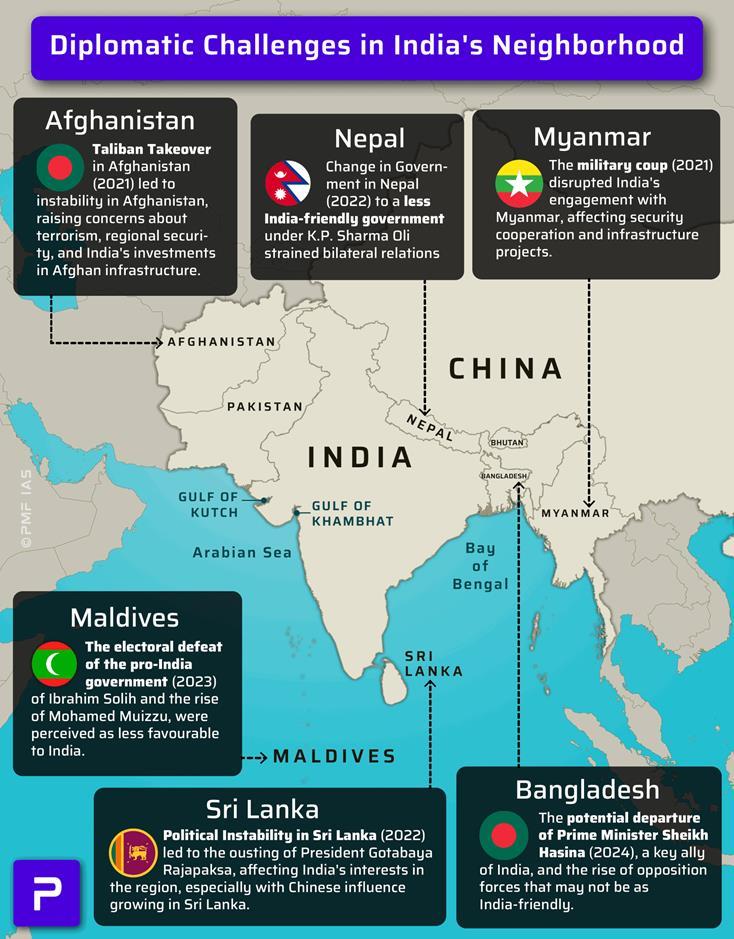
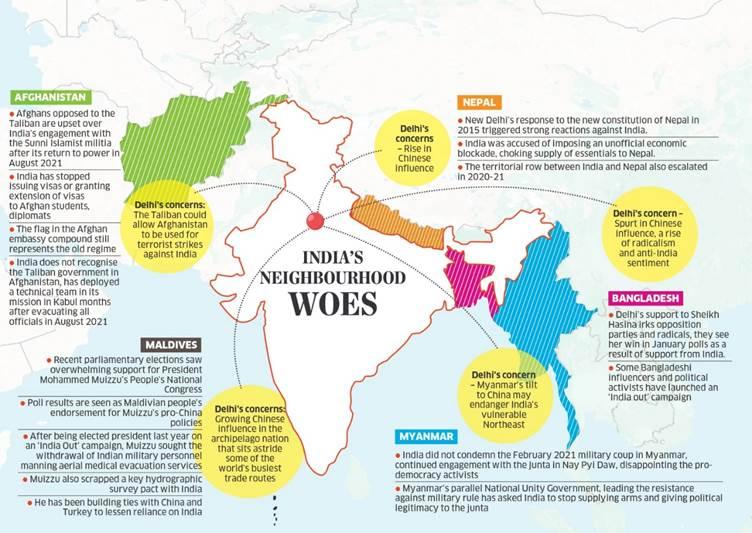
Instability in India’s Neighbourhood
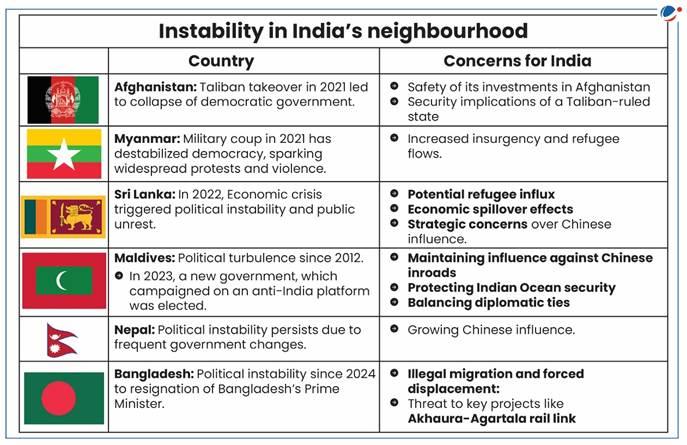
Challenges in Neighbourhood Policy
- Border disputes: LAC with China, LOC with Pakistan.
- Cross-border terrorism: Primarily from Pakistan-based groups.
- China’s Influence: BRI penetration in almost all neighbours except Bhutan.
- Water-sharing disputes: Indus Treaty (Pakistan), Teesta (Bangladesh).
- Political instability: Myanmar coup (2021), Sri Lankan crisis.
- Perception issues: “Big brother” image affecting trust.
Way Forward
- Economic Integration – Raise South Asia’s intra-regional trade from current ~5% to 20% (World Bank data).
- Security Cooperation – Maritime domain awareness, counter-terror coordination under SAARC/BIMSTEC.
- Soft Power Diplomacy – Buddhism, Bollywood, cricket, and educational exchanges.
- Competitive Infrastructure Financing – Alternatives to Chinese BRI with transparency.
- Inclusive Diplomacy – Engage all political stakeholders in neighbouring countries.
Conclusion
- Neighbourhood stability is essential for India’s rise as a global power.
- Quote for Mains:
“India cannot rise to its full potential without the prosperity of its neighbourhood.” – Former PM I.K. Gujral - Strategic vision must blend security pragmatism, economic interdependence, and cultural connect to create a stable and cooperative periphery.


